Force, Load & Torque
Load cells, strain-based sensors and torque transducers measure mechanical force, weight or twisting load.
Industrial sensors detect physical quantities or process conditions and provide information a control or measurement system can use. Common categories include temperature, pressure, proximity, position and distance, flow and level, vibration and acceleration, as well as force/load, humidity and gas sensing.
Choose the measured quantity first, then compare sensing principle, measurement range, process connection, environment, response, accuracy requirements and output interface.
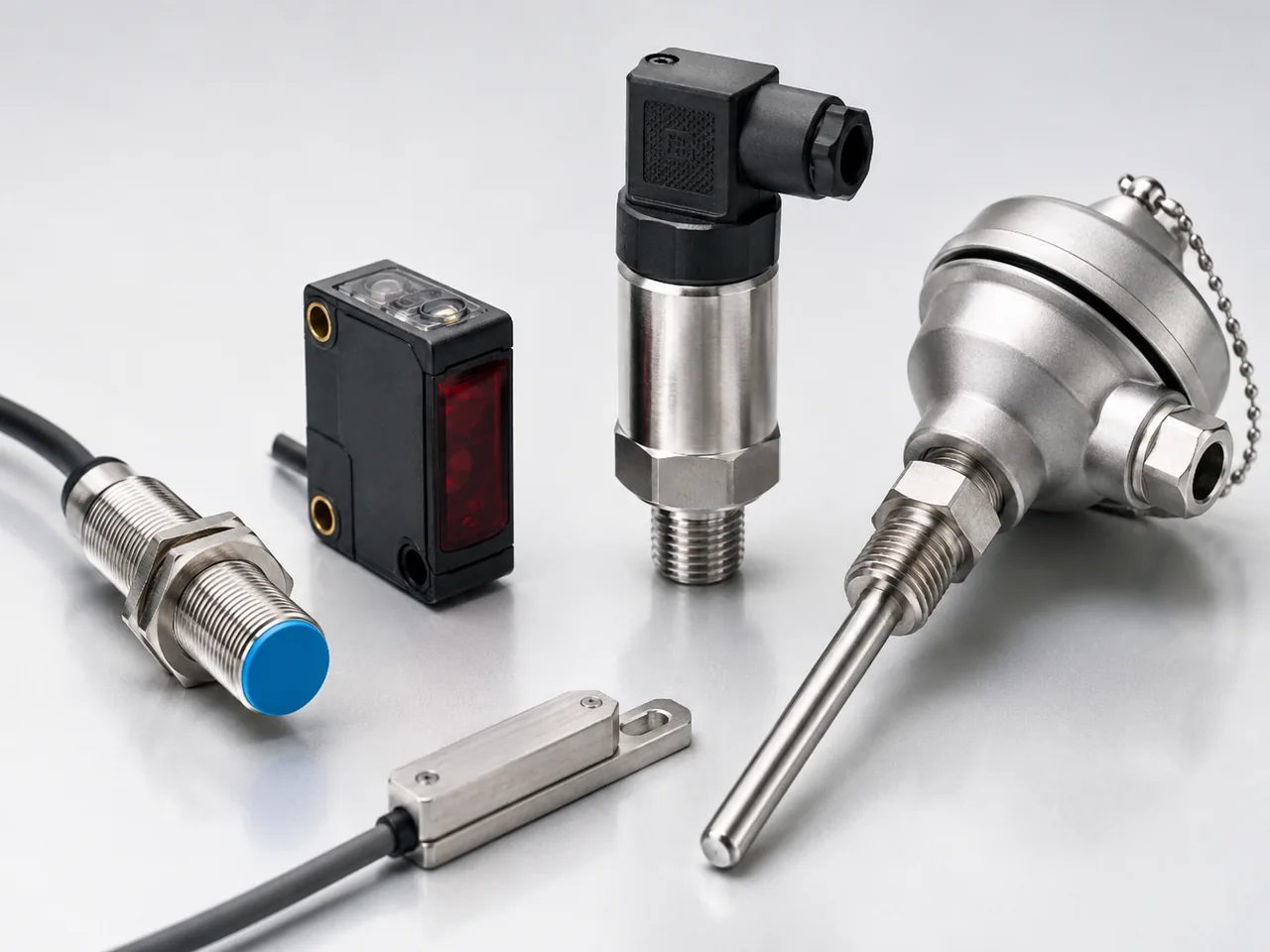
Start with what must be measured or detected. The sensing technology and electrical output are separate choices that follow from the application.
Compare RTDs, thermocouples, thermistors and semiconductor devices by range, wiring, installation and signal interface.
OPEN →Choose gauge, absolute or differential pressure sensing for process lines, pneumatic and hydraulic circuits, and machine monitoring.
OPEN →Choose inductive, capacitive, photoelectric, magnetic or ultrasonic detection according to target material, sensing range and environment.
OPEN →Linear, angular and non-contact measurement using magnetic, optical, ultrasonic and displacement technologies.
OPEN →Flow sensors measure rate or total flow, while level sensors provide continuous measurement or point detection in liquids and bulk materials.
OPEN →Accelerometers and velocity sensors monitor machinery vibration, motion and dynamic acceleration using piezoelectric, MEMS and other suitable sensing principles.
OPEN →The sensing element responds to the quantity or condition of interest. Electronics may then condition, linearise or convert that response before the device presents an analogue, switching, pulse or digital interface.
The receiving PLC, controller or measuring instrument interprets that output and converts it into a state, count or engineering value. Both the physical measurement and the electrical interface must be considered when selecting a sensor.
A sensor that works on a clean test bench may be unsuitable for the actual process pressure, ambient temperature, vibration, washdown, chemical exposure, hazardous-area requirements or mechanical loading.
Process sensors often require the correct process connection, insertion depth, wetted materials, sealing method and enclosure rating. Machine sensors may instead depend on sensing distance, target material, mounting clearance, switching frequency or resistance to shock and vibration.
Installation can also change the measurement itself. Temperature sensors need adequate thermal coupling; pressure connections can trap gas or condensate; ultrasonic and optical sensors require a usable path to the target; vibration sensors depend on mounting stiffness and orientation.
Installation constraints and operating conditions can affect sensor performance as much as the stated specifications.
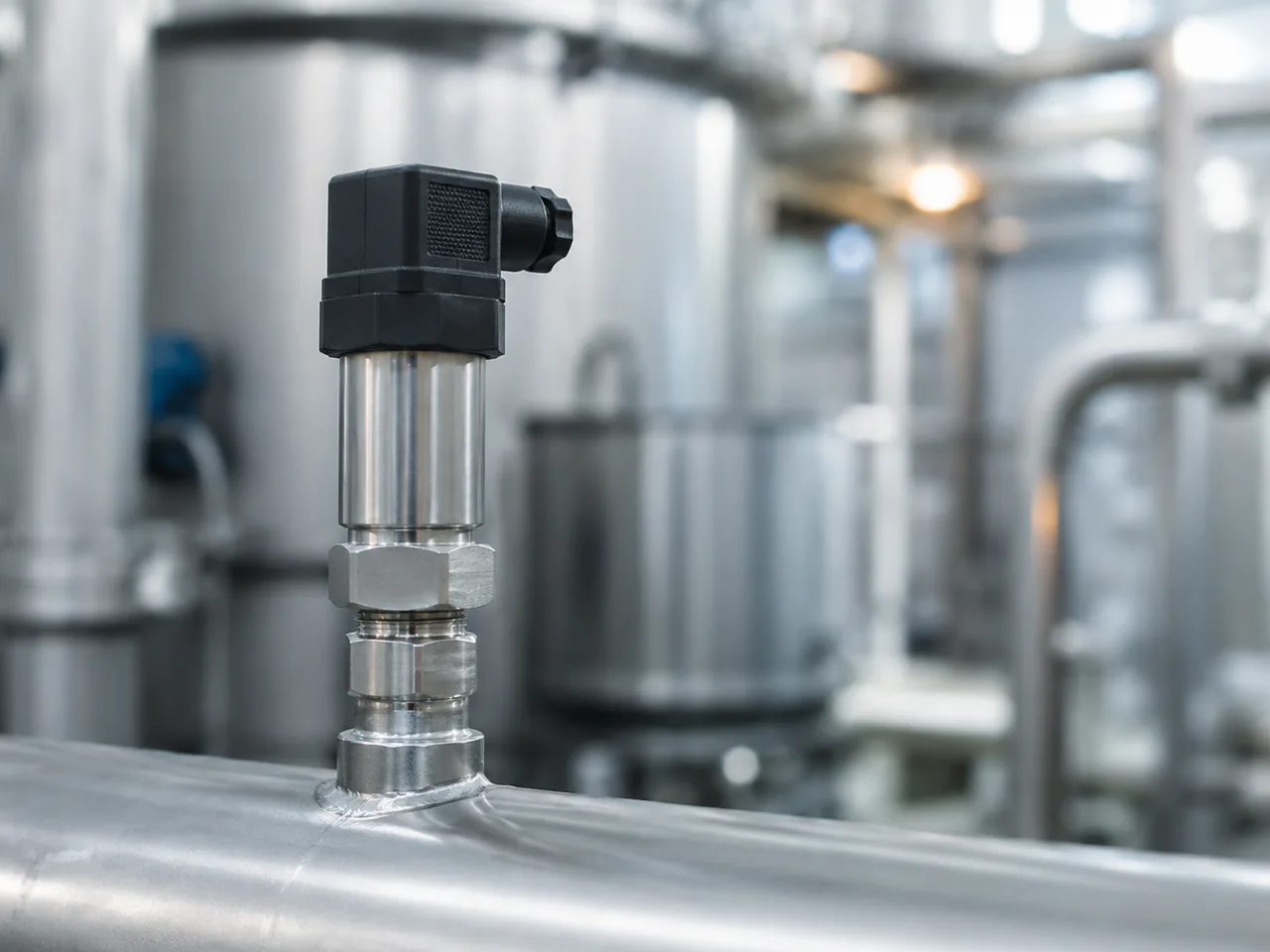
Do not treat a sensor category as one technology. Pressure, temperature, position and level can each be measured by several principles with different strengths and limitations.
| Measured quantity | Common sensing principles | Selection considerations |
|---|---|---|
| Temperature | RTD, thermocouple, thermistor, semiconductor | Temperature range, accuracy, response time, sheath, process connection and transmitter requirements. |
| Pressure | Piezoresistive, capacitive, strain-based and resonant methods | Gauge/absolute/differential reference, pressure range, overload, media compatibility and process connection. |
| Presence / proximity | Inductive, capacitive, photoelectric, magnetic, ultrasonic | Target material, sensing distance, background, alignment, switching speed and environment. |
| Position / distance | Optical, magnetic, inductive, ultrasonic, potentiometric, encoder | Range, resolution, repeatability, contact/non-contact operation, motion speed and mounting geometry. |
| Flow / level | Differential pressure, magnetic, ultrasonic, radar, thermal, turbine, capacitive | Fluid or material, conductivity, density, pipe or vessel geometry, process conditions and required range. |
| Vibration / acceleration | Piezoelectric accelerometer, MEMS capacitive, electrodynamic velocity transducer | Frequency range, amplitude, mounting, axis, temperature, signal conditioning and cable behaviour. |
Beyond the main automation and process categories, industrial systems also use specialised sensors for force, atmosphere, composition and optical inspection.
Load cells, strain-based sensors and torque transducers measure mechanical force, weight or twisting load.
Sensors measure relative humidity, dew point or material moisture where environmental or process conditions depend on water content.
Gas detectors and analytical sensors identify or quantify selected gases or chemical properties using application-specific sensing methods.
Vision sensors, cameras and optical inspection devices check presence, position, shape, markings or surface features.
Many industrial sensors and transmitters are offered with several output interfaces. The PLC or measuring system must be compatible with the selected version.
Common for process transmitters where a measured value is carried as loop current.
Voltage output for analogue measurement where source, reference and receiving input are compatible.
Discrete transistor outputs used for proximity, position, pressure and other switching functions.
Useful for encoders, speed pickups, flowmeters and event sensors when the receiving system can count edges or measure frequency.
Some sensors also provide digital communication such as IO-Link or other protocol-based interfaces. These interfaces can carry measurement values, diagnostics and configuration data. With conventional industrial sensor signals and output types, the supply, current path, reference and PLC input must be matched electrically.
The sensor must cover the real operating range, survive the process and environment, fit the mechanical installation, meet the required measurement performance and provide an output the receiving system can use.
Define what is measured, normal operating range, expected extremes and any overload or fault conditions.
Check temperature, pressure, moisture, chemicals, vibration, washdown, dust and hazardous-area requirements where applicable.
Confirm process connection, mounting space, target geometry, insertion depth, orientation and service access.
Specify accuracy, repeatability, resolution, response time, frequency range or switching behaviour only as required by the task.
Match supply, output type, wiring, PLC input, cable requirements and any signal-conditioning or isolation needs.