
SI Units & Unit Conversions for Sensors & Measurement
The International System of Units (SI) provides a consistent basis for sensor specifications and measurement results. Convert only between units of the same physical quantity, keep prefixes and unit symbols case-sensitive, and distinguish simple scale-factor conversions from offset conversions such as °C to °F.
Pressure, temperature, flow, length, force and electrical signals are often reported in several unit systems. The conversion must preserve the physical quantity, reference condition and measurement basis—not only the numerical value.
Unit symbols are not abbreviations. Write 5 mm, 20 °C, 250 kPa and 4 mA with a space between the number and unit symbol; do not pluralise symbols or add a full stop unless normal punctuation requires one.
The SI is built from seven base units and coherent derived units
The SI has seven base quantities and base units. Other SI units are formed from these through algebraic relations. For sensor engineering, the most frequently encountered derived units include the pascal for pressure, newton for force, joule for energy, watt for power, volt for electric potential, ohm for resistance and hertz for frequency.
| Base quantity | SI unit | Symbol | Typical sensor context |
|---|---|---|---|
| Time | second | s | Sampling, response time, pulse period |
| Length | metre | m | Position, displacement, distance, level |
| Mass | kilogram | kg | Mass, density, mass flow |
| Electric current | ampere | A | 4–20 mA loops and current measurement |
| Thermodynamic temperature | kelvin | K | Temperature and temperature compensation |
| Amount of substance | mole | mol | Gas and chemical measurement calculations |
| Luminous intensity | candela | cd | Optical and photometric measurement |
Prefix and unit symbols are case-sensitive
SI prefixes form decimal multiples and submultiples. In sensor work, the difference between uppercase and lowercase symbols is critical: m can mean metre when used as a unit or milli when used as a prefix, while M means mega. The prefix is attached directly to the unit symbol and only one prefix is used at a time.
| Prefix | Symbol | Factor | Example |
|---|---|---|---|
| giga | G | 10⁹ | GHz |
| mega | M | 10⁶ | MPa, MΩ |
| kilo | k | 10³ | kPa, kΩ |
| milli | m | 10⁻³ | mm, mA, mV |
| micro | µ | 10⁻⁶ | µm, µA |
| nano | n | 10⁻⁹ | nm, nF |
| pico | p | 10⁻¹² | pF |
Correct notation
- 12.5 kPa
- 4 mA
- 100 µm
- 25 °C
- 293.15 K
Common notation errors
- 12.5 KPa — wrong prefix case
- 4 mA. (mid-sentence) — full stop incorrectly added to the unit symbol
- 100 um — use µm where the character set permits
- 25° C — space belongs before °C, not inside the symbol
- 293.15 °K — kelvin uses K, not °K
The kilogram is a special naming case because the SI base unit already contains the prefix kilo. Decimal multiples and submultiples of mass are normally formed from the gram: 1 mg = 10⁻⁶ kg, 1 g = 10⁻³ kg and 1 Mg = 10³ kg. Forms such as “mkg” are not used.
Industrial sensor quantities often use SI units alongside accepted non-SI units
Sensor datasheets and control systems commonly mix SI and non-SI units. A conversion is valid only when the units represent the same physical quantity. Converting pressure to force, for example, requires an area as additional information; it is not a unit conversion alone.
| Quantity | SI unit | Other common units | Important distinction |
|---|---|---|---|
| Pressure | Pa | kPa, MPa, bar, mbar, psi, atm, Torr | Absolute, gauge and differential reference must be preserved |
| Temperature | K | °C, °F | Temperature values and temperature intervals convert differently |
| Volume flow | m³/s | m³/h, L/min, L/s, US gal/min | Gas reference conditions matter for standardised volume flow |
| Mass flow | kg/s | kg/h, t/h, lb/h | Do not convert directly to volume flow without density |
| Length | m | mm, µm, inch, foot | Area and volume require squared or cubed conversion factors |
| Force | N | kN, lbf | Mass and force are different quantities |
| Frequency | Hz | kHz, rpm | rpm is rotational rate; 1 Hz = 60 rpm only for one event per revolution |
Other common derived quantities include acceleration in m/s², density in kg/m³, torque in N·m and electrical resistance in Ω. The unit expression matters: N·m is used for torque, while the joule is also dimensionally N·m but represents energy. Matching dimensions alone does not make two differently defined quantities interchangeable.
Most unit conversions are scale factors; some also require an offset
For units that share the same zero, conversion is usually multiplication by a constant factor. Pressure between Pa and bar and length between metres and inches are examples. Temperature scales such as Celsius and Fahrenheit use different zero points, so a simple factor is not sufficient for temperature values.
- Identify the quantity. Confirm that both units represent the same quantity: pressure to pressure, length to length, volume flow to volume flow.
- Preserve the reference. Gauge pressure must remain gauge pressure; absolute pressure must remain absolute pressure. Standard gas flow must retain its stated reference conditions.
- Apply the correct factor or equation. Use a traceable conversion factor and enough digits for the required measurement accuracy.
- Round at the end. Keep guard digits through intermediate calculations and round the final result to a precision justified by the source measurement.
When a conversion factor is exact, the conversion itself does not introduce measurement uncertainty. Uncertainty still belongs to the measured value and any non-exact constants used in the measurement model. Using a rounded conversion factor can, however, add a small numerical error, so retain enough digits when accuracy matters.
Temperature values require offsets; temperature intervals do not
Kelvin and degree Celsius have the same unit size, but their zero points differ by exactly 273.15. Therefore a temperature value converts as K = °C + 273.15. Fahrenheit uses both a different zero and a different degree size, so °F = °C × 9/5 + 32.
| Condition | °C | K | °F |
|---|---|---|---|
| Water freezing point at standard pressure | 0 | 273.15 | 32 |
| Example process temperature | 20 | 293.15 | 68 |
| Example process temperature | 100 | 373.15 | 212 |
| Temperature interval | 10 °C interval | 10 K | 18 °F interval |
Pressure conversion is simple only after the reference type is fixed
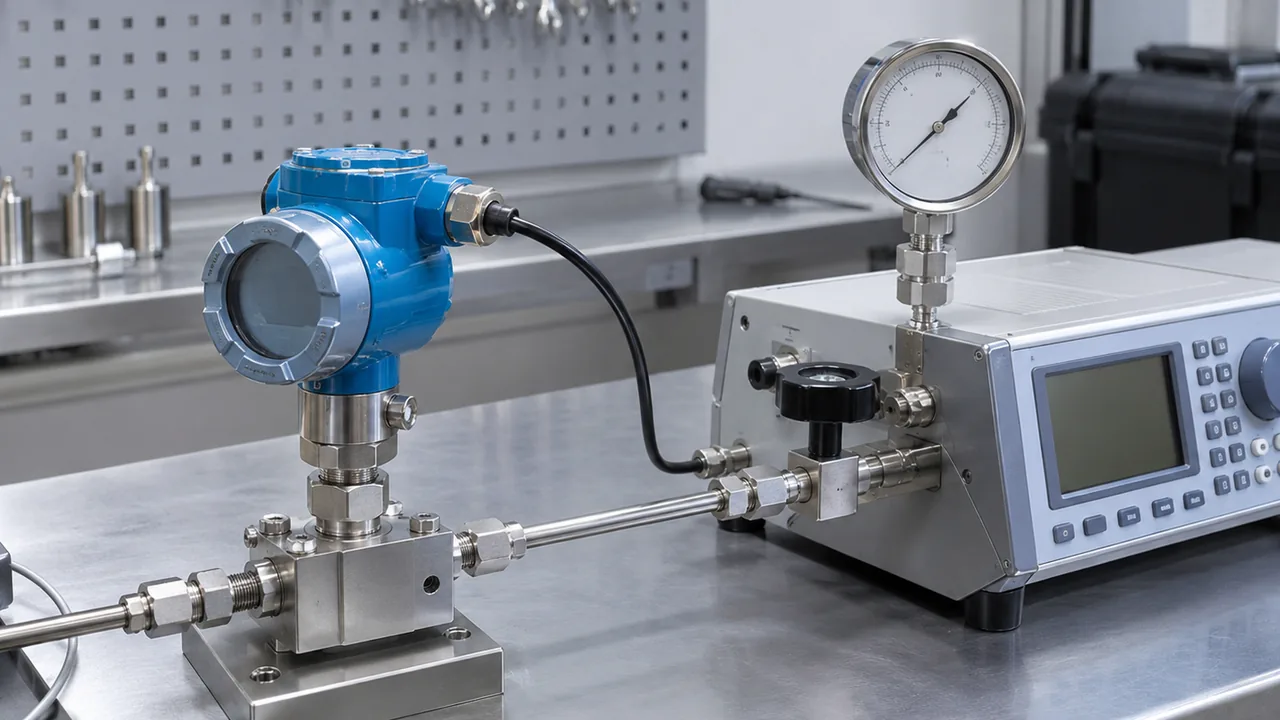
The pascal is the SI unit of pressure: 1 Pa = 1 N/m². Common industrial units convert by fixed scale factors, but the pressure reference—absolute, gauge or differential—must not be changed by the conversion. A reading of 2 bar(g) is not the same physical pressure as 2 bar(a).
| Starting unit | Equivalent in pascals | Useful relation |
|---|---|---|
| 1 kPa | 1 000 Pa | 100 kPa = 1 bar |
| 1 MPa | 1 000 000 Pa | 1 MPa = 10 bar |
| 1 bar | 100 000 Pa | 1 bar = 100 kPa |
| 1 psi | ≈ 6 894.757 Pa | 1 bar ≈ 14.5038 psi |
| 1 atm | 101 325 Pa | 1 atm = 101.325 kPa |
| 1 Torr | ≈ 133.322 Pa | 760 Torr = 1 atm |
Liquid volume-flow conversion is straightforward; gas flow may depend on reference conditions
For an incompressible liquid, conversions among m³/s, m³/h, L/s and L/min are scale-factor conversions. Gas flow is different when the reported value is a standardised or normalised volume flow, because the numerical volume depends on the reference temperature, pressure and sometimes humidity or gas composition.
| Starting value | Equivalent | Equivalent |
|---|---|---|
| 1 m³/s | 3 600 m³/h | 60 000 L/min |
| 1 m³/h | 16.6667 L/min | 0.277778 L/s |
| 1 L/min | 0.06 m³/h | 0.0166667 L/s |
| 1 US gal/min | 3.785411784 L/min | 0.2271247 m³/h |
Do not treat standardised volume flow as actual pipe volume flow without converting through the applicable gas state. A mass-flow device can report kg/h independently of downstream display units, while a volumetric device may require pressure and temperature data before an equivalent mass flow can be calculated.
Electrical signal scaling and engineering-unit conversion are separate steps
A transmitter converts a physical quantity to an electrical signal such as 4–20 mA or 0–10 V. The PLC, controller or DAQ then scales that signal back into an engineering quantity. If the desired display unit changes from bar to kPa, the engineering-unit conversion should be applied to the scaled physical value rather than changing the electrical meaning of 4 mA or 20 mA.
| Loop current | 0–10 bar scaling | Equivalent 0–1000 kPa scaling |
|---|---|---|
| 4 mA | 0 bar | 0 kPa |
| 8 mA | 2.5 bar | 250 kPa |
| 12 mA | 5 bar | 500 kPa |
| 16 mA | 7.5 bar | 750 kPa |
| 20 mA | 10 bar | 1 000 kPa |
For non-linear sensors, conversion can also be embedded in the transfer relation. Thermocouple voltage, RTD resistance and differential-pressure flow are examples where the physical measurement model is not merely a change of display units.
Most unit-conversion mistakes come from the quantity definition, not the arithmetic
- Write the quantity with every value. “250” is incomplete; “250 kPa(g)” carries both unit and pressure reference.
- Check prefix case. m, µ, k and M differ by factors of thousands or millions.
- Separate value from interval for temperature. A 10 °C rise is a 10 K interval, not a conversion to 283.15 K.
- Square or cube the conversion factor where required. Area and volume do not use a linear length factor.
- Preserve gas reference conditions. Standard or normal volume flow must retain the reference temperature and pressure.
- Do not confuse mass with force. Kilogram is a unit of mass; newton is a unit of force.
- Keep enough digits through the calculation. Premature rounding can create an avoidable error larger than the sensor resolution.
- Record the conversion in the measurement chain. PLC scaling, historian units and exported data should use the same quantity definition and unit metadata.